Event Catalog
Browse 117 professional development events

Excel Spreadsheets — Ensuring Data Integrity and 21 CFR Part 11 Compliance
Avoid FDA 483s by properly configuring and validating GxP-compliant Excel spreadsheets — with live step-by-step setup of audit trails, security features, and data entry verification.
 David Nettleton
Complaint Handling and Investigation: Linking CAPA, MDR Reporting, Trend Evaluation, and Recall Considerations
This session examines complaint handling from a lifecycle perspective, focusing on how complaint information drives downstream quality and regulatory decisions.
 Meredith Crabtree
Cleaning Validation Lifecycle Control: Monitoring Drift, Method Sensitivity, and Revalidation Decisions
This session examines cleaning validation from a lifecycle perspective, focusing on how organizations maintain confidence in validated cleaning processes long after initial approval.
Meredith Crabtree
Human-in-the-Loop (HITL) in GMP: Maintaining Human Oversight of AI-Assisted Decisions
Human-in-the-Loop is not simply having a person present. Effective HITL requires meaningful human oversight, defined decision authority, documented intervention, traceability, and lifecycle monitoring proportional to GMP risk.
 Dr. Ginette Collazo
Vendor Assurance for AI and Cloud-Based GxP Systems: What You Can Leverage, Challenge, and Independently Verify
A risk-based framework for vendor assurance of AI-enabled and cloud-based GxP systems: which vendor evidence you can leverage, which claims you must challenge, and which controls or outcomes you must independently verify.

ChatGPT-Assisted Technical Writing
Learn practical, compliant approaches to using ChatGPT for SOP drafting, document development, and technical writing in regulated industries.
 Charles H. Paul
Using SPC and Process Data to Support Quality, Stability, and Manufacturing Decisions
Learn how SPC, Six Sigma, and process data support CGMP production controls — sampling plan justification, verification/validation, and trend analysis for non-conformances, complaints, and CAPAs.
 John E. Lincoln
Root Cause Analysis for GMP Investigations: Identifying Systemic Failures and Building Effective CAPA
Master closed-loop CAPA with repeatable failure investigation and root cause analysis tools that satisfy FDA audit expectations in GMP environments.
John E. LincolnData Integrity: What Exactly Is Required for 21 CFR Part 11, SaaS/Cloud, EU GDPR
Get complete clarity on 21 CFR Part 11, Annex 11, SaaS/Cloud compliance, AI software validation, and EU GDPR requirements for regulated industries.
David Nettleton
Risk-Based CSV/CSA for Modern GxP Systems: Making Defensible Validation Decisions in Practice
A two-day, risk-based framework for CSV/CSA and GAMP® 5 validation decisions on modern GxP systems — cloud, SaaS, configurable, and AI-enabled platforms — built for inspection readiness.
 Carolyn Troiano
Acceptance Criteria for AI Validation: Determining What "Reliable" Actually Means in GxP Systems
Learn how to define meaningful, risk-based acceptance criteria for AI systems in GxP environments — covering reliability thresholds, hallucination controls, human guardrails, and CSA-aligned validation strategies.
Carolyn Troiano
Audit Trail Review by Exception: Reducing Reviewer Burden Without Weakening Detection
Learn how to implement a risk-based audit trail review-by-exception strategy that reduces reviewer fatigue while strengthening detection of critical compliance, data integrity, and cybersecurity risks.
Carolyn TroianoAnnex 22 and AI Governance for GMP: Human Review, Model Monitoring, and Change Control
Meet EU Annex 22 AI governance requirements in GMP — covering human review, model monitoring, change control, CSV vs CSA, GAMP®5, and inspection readiness for AI/ML systems.
Carolyn Troiano
Digital Quality Metrics and AI/ML Analytics: Building a Continuous-Improvement Framework that Aligns with Regulatory Expectations
Learn how AI/ML and real-time digital quality metrics build a continuous-improvement framework aligned with FDA regulatory expectations, 21 CFR Part 11, and GAMP®5.
Carolyn TroianoAnalytical Lifecycle Management Under ICH Q14 and Q2(R2): What Changes Operationally
Understand the operational impact of ICH Q14 and Q2(R2) on analytical method development, validation, transfer, and lifecycle management in regulated pharmaceutical environments.
Meredith CrabtreeUsing EU GMP Annex 22 as the Framework for Governing AI Systems, Validation Traceability, and Data Integrity Controls
Learn how to apply EU GMP Annex 22 as a practical framework for AI system governance, validation traceability, lifecycle management, and data integrity controls in regulated pharmaceutical and biotech environments.
Charles H. Paul
Advanced Therapy GMP Release and Chain-of-Identity Controls
Learn how to establish chain-of-identity controls, manage GMP release decisions, and build traceability systems for cell therapy, gene therapy, and ATMP manufacturing.
Charles H. PaulAI for CAPA and Investigations: Where It Helps and Where It Can Get You in Trouble
Learn where AI genuinely helps CAPA and investigations — and where it creates regulatory risk by replacing evidence-based analysis with generated logic.
Charles H. Paul
OTC Monograph Reform and OMUFA II: What FDA's Modernized OTC Framework Means for Manufacturers
Understand the practical impact of FDA's modernized OTC monograph system and OMUFA II obligations on daily regulatory, quality, manufacturing, and compliance decisions.
Meredith Crabtree
AI-Assisted Post-Market Surveillance and Signal Detection: What Regulators Will Still Expect Humans to Defend
AI tools can detect signals — but regulators still expect humans to interpret, escalate, and defend every post-market surveillance decision under FDA and EU MDR.
Meredith CrabtreeAI and Decision Making in GMP: Resolving Conflicts Between Human Judgment and AI Recommendations
Learn how to govern AI-assisted decisions in GMP operations — when to trust AI recommendations, when human judgment must override them, and how to document it all for inspection readiness.
Dr. Ginette Collazo
AI in GMP: What the FDA Is Already Expecting - Before You Ask
FDA already expects GMP compliance for AI systems. Learn how existing validation, data integrity, and oversight rules apply—before regulators come calling.
Dr. Ginette Collazo
The First FDA Warning Letter on AI: What It Means for Your Quality System
The FDA issued its first AI-related Warning Letter. Learn what it means for your QMS, validation requirements, and how to keep your quality systems inspection-ready.
Dr. Ginette CollazoAI Errors May Be Impossible to Eliminate — What That Means for Its Use in the FDA
AI errors may be statistically unavoidable. Learn how to build controls, oversight, and governance models that make AI safe, compliant, and inspection-ready in FDA-regulated environments.
Dr. Ginette Collazo
Packaging and Labeling Controls: Reducing Hidden Errors Before They Escalate
Understand how to reduce hidden packaging and labeling errors in pharmaceutical manufacturing — covering proactive controls, AI-driven process improvements, and supply chain performance strategies.
 Michael Esposito
Measuring SOP Effectiveness Across Training, Qualification, GMP Operations, and AI-assisted environments
Learn how to measure and improve SOP effectiveness across training, qualification, GMP operations, and AI-assisted environments — connecting documentation, compliance, and workforce performance.
Michael EspositoChange Control for SaaS and AI Systems: Managing Configuration Drift and Revalidation Without Creating Validation Backlogs
Validating Interfaces Between GxP Systems: Data Transfers, APIs, Middleware, and Integration Failures
Risk-Based CSV/CSA for Modern GxP Systems: Making Defensible Validation Decisions in Practice
A two-day, risk-based framework for CSV/CSA and GAMP® 5 validation decisions on modern GxP systems — cloud, SaaS, configurable, and AI-enabled platforms — built for inspection readiness.
Carolyn TroianoUsing SPC and Process Data to Support Quality, Stability, and Manufacturing Decisions
Learn how SPC, Six Sigma, and process data support CGMP production controls — sampling plan justification, verification/validation, and trend analysis for non-conformances, complaints, and CAPAs.
John E. LincolnOnboarding In A GMP Environment — Best Practices
Build a compliant and effective GMP onboarding program — cover training coordination, contractor vs. employee differences, and how to reduce the compliance learning curve.
Michael EspositoPart 11, Data Integrity & Documentation for SaaS/PaaS Validation — 3-Hour Course
A 3-hour deep dive into 21 CFR Part 11 and data integrity for SaaS/PaaS cloud systems — covering audit trails, shared responsibility, change management, and FDA inspection readiness.
Carolyn TroianoHow to Validate Automated Pipelines Under CSA — 3-Hour Course
A 3-hour course on validating CI/CD pipelines and automated workflows under CSA — challenge-based testing, automated evidence, and maintaining audit readiness in rapid-release environments.
Carolyn TroianoChatGPT and AI-Powered Project Management — Revolutionize Your Projects Now
Harness ChatGPT and AI tools to streamline workflows, automate routine project tasks, and improve decision-making accuracy across the full project management lifecycle.
Charles H. PaulExcel Spreadsheets — Ensuring Data Integrity and 21 CFR Part 11 Compliance
Avoid FDA 483s by properly configuring GxP-compliant Excel spreadsheets — step-by-step setup of audit trails, security features, Part 11 compliance, and minimal-documentation validation.
David NettletonFDA Labeling and UDI Essentials for Medical Products
Turn FDA labeling and UDI requirements into a controlled, inspection-ready system — cover 21 CFR 801, DMR linkage, misbranding risk, IFUs, and GUDID compliance.
 José Mora
Drug Master Files (DMFs) — Understanding and Meeting Your Global Regulatory and Processing Responsibilities
Master Drug Master File creation, submission, and lifecycle management — navigate FDA and EMA requirements, protect proprietary information, and maintain global regulatory compliance.
Charles H. PaulBad Standard Operating Procedures (SOPs) — Bad Training: Garbage In, Garbage Out — 3-Hour Course
Fix bad SOPs at the source — a 3-hour course covering SOP writing parameters, training development, curriculum design, LMS considerations, and ongoing knowledge retention assessment.
Michael EspositoFDA Inspections After QMSR: What Replaces QSIT 2.0 — The New Inspection Reality
Understand the new QMSR inspection reality — what replaces QSIT, how FDA will inspect under ISO 13485 alignment, and how to manage the hybrid compliance burden of QSR + QMSR.
John E. LincolnProject Management Best Practices for Computer Systems Regulated by FDA
Apply project management best practices to FDA-regulated computer system implementations — covering SDLC, CSV, GAMP V, roles, documentation, and maintaining systems in a validated state.
Carolyn TroianoStep-by-Step Process for Successful Sterility Failure Investigations
A step-by-step guide to investigating sterility test failures — covering FDA regulations, root cause tools, lot impact assessment, and audit-ready documentation.
 Danielle DeLucy
Data Integrity and Documentation Excellence
Go beyond theory — understand how ALCOA+ appears in real records, how Part 11 applies to electronic systems, and how to design documentation that withstands audits.
Charles H. PaulLeveraging AI in Risk Assessment for Smarter Computer Systems Validation
Apply AI responsibly to CSV risk assessment — build defensible, inspection-ready risk models that align with CSA, GAMP 5, and FDA data integrity expectations.
Carolyn TroianoDeviations, CAPA and Change Control
Move beyond superficial root causes — build defensible deviation reports, sustainable CAPA, and change control aligned with 21 CFR 820.100 and GMP expectations.
Charles H. PaulCybersecurity Expectations for GxP Systems
Translate FDA cybersecurity expectations into inspection-ready GxP actions — covering SDLC touchpoints, cloud/SaaS responsibilities, access control, and audit trail requirements.
Carolyn TroianoGood Clinical Practices (GCP) Audit and Inspection Readiness
Build GCP audit and inspection readiness — cover QMS, SOPs, documentation, internal audits, and personnel training to ensure compliant clinical trial execution.
Charles H. PaulFDA Registration, Listing & Facility Licensing — Common Pitfalls and Best Practices
Cut through recurring FDA registration, listing, and facility licensing errors — avoid misclassifications, missed updates, and common pitfalls under 21 CFR Part 807 and Part 820.
Meredith CrabtreeDigital Quality Metrics and AI/ML Analytics: Building a Continuous-Improvement Framework that Aligns with Regulatory Expectations
Learn how AI/ML and real-time digital quality metrics build a continuous-improvement framework aligned with FDA regulatory expectations, 21 CFR Part 11, and GAMP®5.
Carolyn TroianoRecording available
AI in GMP: What the FDA Is Already Expecting - Before You Ask
FDA already expects GMP compliance for AI systems. Learn how existing validation, data integrity, and oversight rules apply—before regulators come calling.
Dr. Ginette CollazoRecording available
ChatGPT-Assisted Technical Writing
Learn practical, compliant approaches to using ChatGPT for SOP drafting, document development, and technical writing in regulated industries.
Charles H. PaulRecording available
Root Cause Analysis for GMP Investigations: Identifying Systemic Failures and Building Effective CAPA
Master closed-loop CAPA with repeatable failure investigation and root cause analysis tools that satisfy FDA audit expectations in GMP environments.
John E. LincolnRecording available
Data Integrity: What Exactly Is Required for 21 CFR Part 11, SaaS/Cloud, EU GDPR
Get complete clarity on 21 CFR Part 11, Annex 11, SaaS/Cloud compliance, AI software validation, and EU GDPR requirements for regulated industries.
David NettletonRecording available
AI Errors May Be Impossible to Eliminate — What That Means for Its Use in the FDA
AI errors may be statistically unavoidable. Learn how to build controls, oversight, and governance models that make AI safe, compliant, and inspection-ready in FDA-regulated environments.
Dr. Ginette CollazoRecording available
AI-Assisted Post-Market Surveillance and Signal Detection: What Regulators Will Still Expect Humans to Defend
AI can detect signals — but regulators will still expect humans to interpret, defend, and document post-market surveillance decisions. Learn what that looks like under FDA and EU MDR.
Meredith CrabtreeRecording available
Annex 22 and AI Governance for GMP: Human Review, Model Monitoring, and Change Control
Meet EU Annex 22 AI governance requirements in GMP — covering human review, model monitoring, change control, CSV vs CSA, GAMP®5, and inspection readiness for AI/ML systems.
Carolyn TroianoRecording available
The First FDA Warning Letter on AI: What It Means for Your Quality System
The FDA issued its first AI-related Warning Letter. Learn what it means for your QMS, validation requirements, and how to keep your quality systems inspection-ready.
Dr. Ginette CollazoRecording available
Determining Root Cause in Sterility Failure Investigations
A practical investigation framework for tracing sterility failures through laboratory, manufacturing, environmental, and contamination-source evidence to establish a defensible root cause, determine the impact on affected batches, and support appropriate corrective actions.
Vendor Assurance for AI and Cloud-Based GxP Systems: What You Can Leverage, Challenge, and Independently Verify
A risk-based framework for vendor assurance of AI-enabled and cloud-based GxP systems: which vendor evidence you can leverage, which claims you must challenge, and which controls or outcomes you must independently verify.
Recording available
FDA Warning Letters & Computerized Systems: From Validation Failures to Inspection-Ready CSV/CSA
Learn what FDA warning letters reveal about software validation, data integrity, audit trails, Part 11, CSV, CSA, change control and inspection readiness.
Meredith Crabtree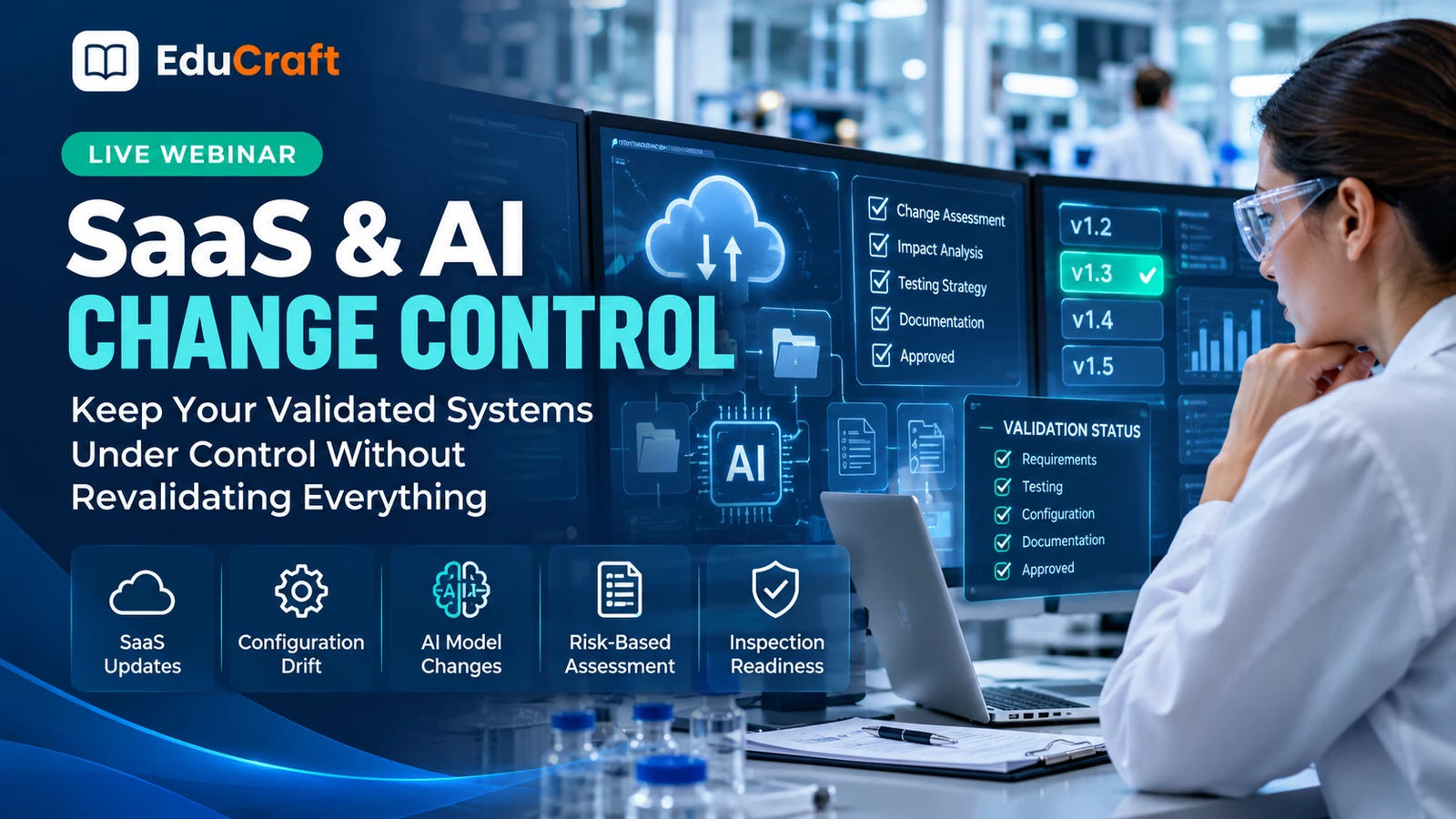
SaaS & AI Change Control: Keep Your Validated Systems Under Control Without Revalidating Everything
Learn how to manage SaaS updates, configuration drift, vendor releases and AI model changes using risk-based change control—without turning every update into a full revalidation project.
Carolyn TroianoRisk Management for AI/ML Medical Devices: Applying ISO 14971 and ISO/TS 24971-2:2026
AI and Decision Making in GMP: Resolving Conflicts Between Human Judgment and AI Recommendations
Learn how to govern AI-assisted decisions in GMP operations — when to trust AI recommendations, when human judgment must override them, and how to document it all for inspection readiness.
Dr. Ginette CollazoRecording available
Analytical Lifecycle Management Under ICH Q14 and Q2(R2): What Changes Operationally
Understand the operational impact of ICH Q14 and Q2(R2) on analytical method development, validation, transfer, and lifecycle management in regulated pharmaceutical environments.
Meredith CrabtreeRecording available
AI-Assisted Post-Market Surveillance and Signal Detection: What Regulators Will Still Expect Humans to Defend
AI tools can detect signals — but regulators still expect humans to interpret, escalate, and defend every post-market surveillance decision under FDA and EU MDR.
Meredith CrabtreeRecording available
AI for CAPA and Investigations: Where It Helps and Where It Can Get You in Trouble
Learn where AI genuinely helps CAPA and investigations — and where it creates regulatory risk by replacing evidence-based analysis with generated logic.
Charles H. PaulRecording available
Advanced Therapy GMP Release and Chain-of-Identity Controls
Learn how to establish chain-of-identity controls, manage GMP release decisions, and build traceability systems for cell therapy, gene therapy, and ATMP manufacturing.
Charles H. PaulRecording available
OTC Monograph Reform and OMUFA II: What FDA's Modernized OTC Framework Means for Manufacturers
Understand the practical impact of FDA's modernized OTC monograph system and OMUFA II obligations on daily regulatory, quality, manufacturing, and compliance decisions.
Meredith CrabtreeRecording available
Acceptance Criteria for AI Validation: Determining What "Reliable" Actually Means in GxP Systems
Learn how to define meaningful, risk-based acceptance criteria for AI systems in GxP environments — covering reliability thresholds, hallucination controls, human guardrails, and CSA-aligned validation strategies.
Carolyn TroianoRecording available
Measuring SOP Effectiveness Across Training, Qualification, GMP Operations, and AI-assisted environments
Learn how to measure and improve SOP effectiveness across training, qualification, GMP operations, and AI-assisted environments — connecting documentation, compliance, and workforce performance.
Michael EspositoRecording available
Audit Trail Review by Exception: Reducing Reviewer Burden Without Weakening Detection
Learn how to implement a risk-based audit trail review-by-exception strategy that reduces reviewer fatigue while strengthening detection of critical compliance, data integrity, and cybersecurity risks.
Carolyn TroianoRecording available
Using EU GMP Annex 22 as the Framework for Governing AI Systems, Validation Traceability, and Data Integrity Controls
Learn how to apply EU GMP Annex 22 as a practical framework for AI system governance, validation traceability, lifecycle management, and data integrity controls in regulated pharmaceutical and biotech environments.
Charles H. PaulRecording available
Packaging and Labeling Controls: Reducing Hidden Errors Before They Escalate
Understand how to reduce hidden packaging and labeling errors in pharmaceutical manufacturing — covering proactive controls, AI-driven process improvements, and supply chain performance strategies.
Michael EspositoRecording available